

Potter's Tavern: A Little Building with an Enormous History...by Bryan Pugh


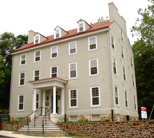
The salt-boxed shaped building that is Potter’s Tavern, located at 49 W Broad St, Bridgeton, NJ
08302, is said to have been constructed in 1770, and thus to be the oldest building still standing
in the city of Bridgeton.
It is also listed on the National Register of Historical Places and still stands in its original location.
Why? Not simply because of its age, but because from 1774 - 1779 the tavern was
operated by Matthew Potter, a standout early entrepreneur who had arrived in 1773 after
previously working in Pennsylvania as a blacksmith. Local colonial taverns around this time
often doubled as the owner’s residence, and this one was so constructed. Half of the first floor
was the dining and kitchen sections for tavern business, and the other side and upper story were
Potter’s living quarters.
What makes this tavern so significant—not only for Bridgeton but for the whole state of
New Jersey—were the weekly newsletters called The Plain Dealer that were exclusively penned
and hosted here from 1774 to around 1780. Remarkably, these are now heralded as the very first
newspaper ever created in the state of New Jersey!
Of course, by today’s standards, The Plain Dealer was less a newspaper than a
‘broadside,’ a kind of editorial or political essay printed, posted, and variously shared with the
public. Even Potter invited anyone who could write to speak their mind and share viewpoints.
So it is no surprise that—besides local gossip and ‘scandals’—these essays openly
broadcasted opinions on many political topics, including the impending struggle against the
British Empire, arguing what the colonists’ response should be, whether they were fighting for
their rights as Englishmen or as a new people. The Plain Dealer, while often focusinghumorously on the particular and sometimes semi-scandalous town gossip of the day, also gave voice to those who were both passionate and indifferent towards the conflict.
Remarkably, the essays that have survived the ravages of time date from December 1775
- February 1776, a particularly interesting moment in American history, since armed skirmishes had
already begun, yet the nation had not yet declared independence. Indeed, Matthew Potter and his
anonymous contributors at the time were risking their lives: they could have been executed for
treason. Just hosting The Plain Dealer at his tavern risked the ire of high-ranking law officials of
Bridgeton still aligned with the British during the Revolution; indeed, the tavern was, then as
now, located right across the road from the Courthouse!
Colonial Bridgeton had about 150 residents at the time. Though Revolutionary War
General Giles may have lived here (up Broad Street, not far from the tavern, actually), the city
never became the center of any Revolutionary War battles or left its mark in the heroic history
books.
Nonetheless, because of Potter and The Plain Dealer, we can credit Bridgeton’s high
level of literacy, and its zeal to spread liberty and patriotism through writing, with actually having
pioneered journalism for the state as a whole.

Fantastic article about the history of Bridgeton!